
The Ultimate Buyer's Guide to Verifiable Privacy Tools Today
In an era dominated by ubiquitous digital tracking, intrusive data brokers, and aggressive regulatory overreach, safeguarding individual digital privacy has shifted from a niche hobby to a fundamental necessity. For years, the commercial privacy industry relied on bold marketing slogans. Consumers were bombarded with assurances of "military-grade encryption," "absolute anonymity," and "zero-logs guarantees." However, high-profile security incidents, undisclosed server logging, and corporate acquisitions of once-trusted tools have permanently eroded faith in unbacked claims.
Modern consumer trust is no longer granted through clever advertising; it is earned through verifiable privacy practices. Choosing software to protect your internet traffic, private communications, or personal files requires a disciplined evaluation framework. This buyer's guide breaks down the essential technical and organizational criteria you must examine to ensure a provider delivers true protection rather than empty promises.

1. Independent Audits: Verification Beyond Promises
A privacy provider's claims are only as reliable as the independent third parties that verify them. In a healthy security model, independent security firms—such as Cure53, Deloitte, PricewaterhouseCoopers (PwC), or Securitum—are granted comprehensive access to inspect software applications, network configurations, and backend servers.
When evaluating a tool's independent audit credentials, pay close attention to three main factors:
- Audit Scope: A client-side application audit checks for software vulnerabilities, but it does not verify whether backend servers store user logs. Look for providers that undergo both codebase audits and infrastructure server audits.
- Audit Recency: Cybersecurity threats and software codebases evolve rapidly. An audit conducted three years ago offers virtually zero assurance regarding today's server deployment. Prioritize services that commit to annual, published audits.
- Unabridged Publication: Avoid services that merely publish a summary blog post claiming they passed an audit. Trustworthy providers release the complete, unedited PDF report detailing the methodology, discovered vulnerabilities, and remediation steps.
2. Transparency Reports and Warrant Canaries
Transparency reports serve as a key indicator of how a company responds to legal pressure and governmental requests. A comprehensive transparency report details the exact number of legal inquiries received—such as subpoenas, court orders, and national security letters—alongside the company's compliance record.
| Verification Pillar | Key Evaluation Metrics | Why It Matters for Consumers |
|---|---|---|
| Independent Audits | Full public reports, annual frequency, complete scope | Validates that backend configurations match public marketing statements. |
| Transparency Reports | Disclosed request counts, zero-data output records | Demonstrates historical resilience against legal demands for user data. |
| Legal Jurisdiction | Outside 5/9/14-Eyes, strong consumer protection laws | Prevents forced surveillance or secret data retention orders. |
| Infrastructure | RAM-only diskless servers, audited deployment scripts | Ensures physical server seizure yields zero recoverable user activity. |
| Client Integrity | Open-source codebases, reproducible builds | Guarantees binaries match audited code without hidden telemetry. |
Complementing transparency reports is the warrant canary. Because some legal jurisdictions allow secret court orders accompanied by gag rules, companies may be legally barred from disclosing a compromise. A warrant canary is a regularly updated, cryptographically signed statement certifying that no gag orders have been served. If the canary fails to update on schedule, users can infer that the platform's integrity may be compromised.
3. Jurisdiction and Legal Frameworks
Where a privacy provider is legally headquartered dictates the law enforcement directives it must obey. A company operating within countries belonging to intelligence-sharing alliances—such as the 5-Eyes, 9-Eyes, or 14-Eyes alliances—is inherently exposed to cross-border data-sharing agreements and potential legal coercion.
Look for providers incorporated in sovereign jurisdictions known for robust statutory privacy rights, such as Switzerland, Iceland, or Panama. These legal environments lack mandatory data retention directives for consumer internet services, allowing companies to legitimately build and operate zero-log systems without violating local laws.
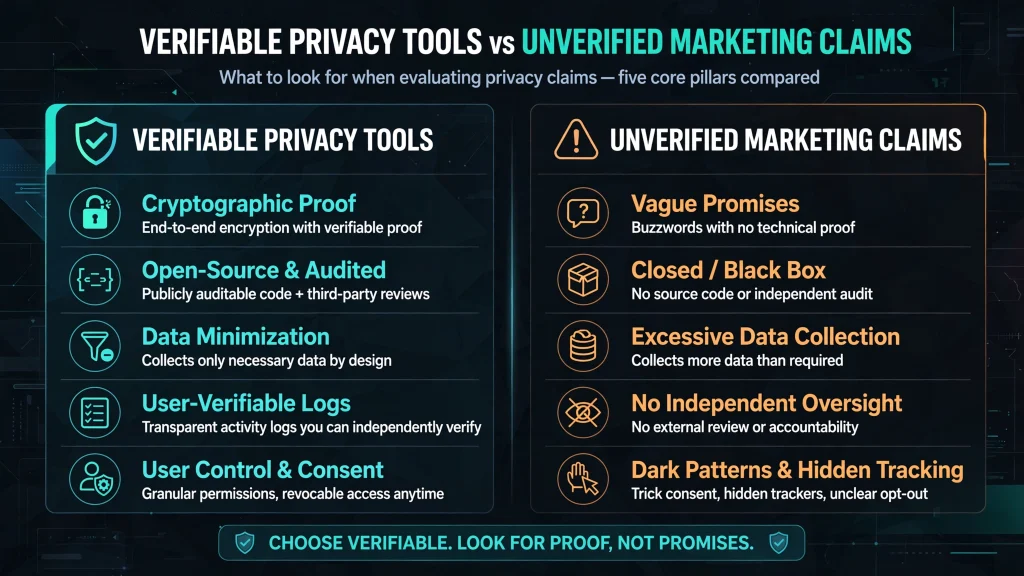
4. Rigorous Data-Retention Practices & RAM-Only Infrastructure
The phrase "no-logs policy" is frequently abused. To properly assess a service's data-retention policy, you must look past headline promises and inspect the granular details of their legal disclosures.
True zero-logs systems refrain from recording:
1. Originating personal IP addresses and assigned server IP addresses. 2. Connection timestamps and bandwidth usage logs. 3. DNS query records and destination web traffic history.
To enforce this programmatically, leading privacy providers deploy RAM-only (diskless) servers. Traditional servers write operating systems and temporary data to permanent hard drives, creating potential forensic trails if hardware is physically seized. In contrast, RAM-only servers run entirely in volatile memory. Whenever power to a server is cycled or disconnected, all stored operational data is permanently wiped instantly, making data harvesting technically impossible.

5. Kill Switches and DNS-Leak Protection
Even the most secure privacy tunnel is useless if your underlying hardware leaks data during network disruptions. Modern operating systems frequently attempt to re-establish dropped network connections or fallback to default Internet Service Provider (ISP) network paths.
Two essential client-side safety mechanisms are mandatory for any robust privacy tool:
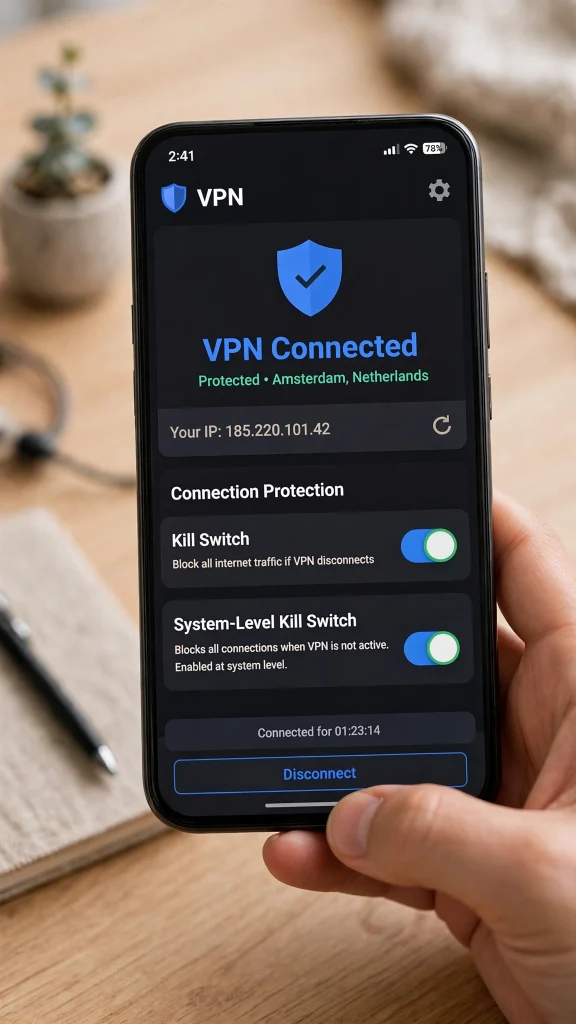
- System-Level Kill Switch: If your secure connection drops unexpectedly due to network instability, a system-level kill switch immediately blocks all incoming and outgoing internet traffic across the entire operating system. This prevents unencrypted packets from leaking to your ISP.
- DNS-Leak Protection: When visiting a website, your device issues a Domain Name System (DNS) request to resolve the URL into an IP address. Without strict DNS-leak protection, your operating system may bypass the secure tunnel and query your ISP's default DNS servers, exposing your entire browsing history. Trustworthy clients enforce hardcoded, encrypted DNS routing within the private tunnel.
6. Open-Source Clients and Reproducible Builds
Proprietary, closed-source software requires users to maintain blind faith in the vendor. Without visible source code, it is impossible for independent researchers to verify whether an application contains backdoors, intrusive analytics trackers, or hardcoded cryptographic flaws.
Open-source client applications allow the global developer community to inspect code repositories continuously. However, publishing source code is only half the battle. Leading services also support reproducible builds. Reproducible builds allow users and third-party auditors to independently compile the public source code and verify that the resulting binary executable matches the exact file distributed in app stores. This guarantees that the software running on your personal device has not been tampered with prior to distribution.
Final Checklist: Buying With Confidence
When choosing your next privacy service, avoid impulse purchases based on promotional discounts or affiliate reviews. Instead, systematically cross-reference your options against these verifiable markers:
- [ ] Are recent, unabridged audit reports publicly accessible?
- [ ] Is the service incorporated in a privacy-respecting jurisdiction?
- [ ] Does the infrastructure run on audited, RAM-only servers?
- [ ] Are client applications fully open-source with reproducible builds?
- [ ] Do desktop and mobile apps feature automatic kill switches and DNS protection?
By prioritizing verifiable infrastructure over marketing rhetoric, you take full control of your digital footprint and ensure your private data remains genuinely secure.