
The enterprise remote access landscape has reached a historic inflection point. As organizations maintain distributed workforces, hybrid operations, and multi-cloud environments in 2026, legacy connectivity tools are falling short under modern operational demands. For over two decades, the Virtual Private Network (VPN) served as the primary gateway for connecting off-site employees to corporate networks. However, as credential theft campaigns accelerate and internet-facing network gateways become prime targets for automated exploit kits, relying on traditional VPN tunnels creates critical vulnerabilities.
To protect sensitive IP, maintain compliance, and reduce attack surfaces, enterprise security leaders are transitioning from implicit perimeter security to Zero Trust Network Access (ZTNA) architectures. This article examines the technological factors driving this shift, provides a detailed comparison between VPN and Zero Trust models, and highlights clear strategies for modernizing enterprise access.

The Structural Flaws of Legacy VPN Architecture
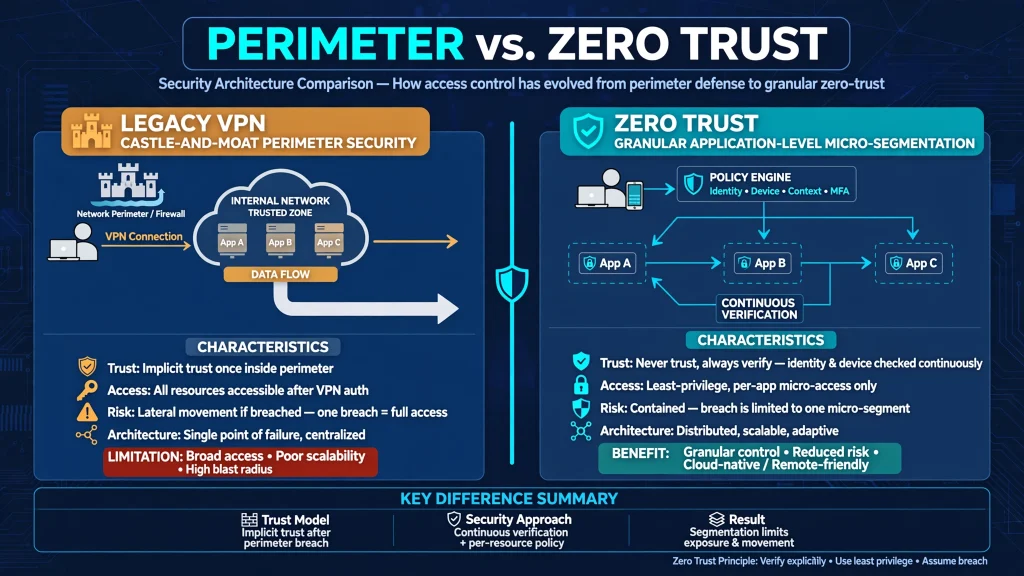
Traditional VPN access relies on the classic "castle-and-moat" defense. In this framework, the corporate data center functions as the castle, firewalls serve as the moat, and the VPN acts as a secure entry drawbridge. Once a remote user authenticates at the perimeter gateway, the system grants broad network-level access across entire internal subnets.
While this architectural approach was effective when applications were hosted exclusively on-premises, several structural limits make legacy VPNs fragile in modern IT environments:
- Exposed Internet Gateways: VPN concentrators must continuously listen for incoming connections over the open internet. Automated threat scanners frequently locate exposed public-facing ports, leaving gateways vulnerable to zero-day vulnerabilities and remote code execution exploits.
- Unrestricted Lateral Movement: VPNs grant broad implicit trust upon initial login. If an attacker steals a single set of employee credentials via spear-phishing, they gain access to entire subnet segments, enabling them to scan internal networks, escalate privileges, and deploy ransomware.
- Performance Bottlenecks: Hairpinning traffic—routing remote employee requests back through a centralized corporate VPN concentrator before sending it out to public SaaS or cloud platforms—causes noticeable latency and degrades network performance.
Core Principles of Zero Trust Network Access
Zero Trust fundamentally shifts the remote access philosophy from implicit trust to explicit, continuous verification. Based on the core mandate to "never trust, always verify," Zero Trust assumes that network perimeters are inherently compromised and treats every access request as a potential risk.
Rather than connecting a remote device directly to the broader corporate network, ZTNA establishes an inside-out, outbound connection model. A lightweight connector inside the network reaches out to a secure broker, keeping internal network gateways hidden from internet scanning tools.
Key components of a robust Zero Trust access policy include:
- Application-Level Micro-Segmentation: Users connect directly to authorized individual applications rather than broad network subnets. Undisclosed services remain completely invisible.
- Least-Privilege Enforcement: Access privileges are scoped tightly to job roles using Just-In-Time (JIT) controls, ensuring users receive only the access required for specific tasks.
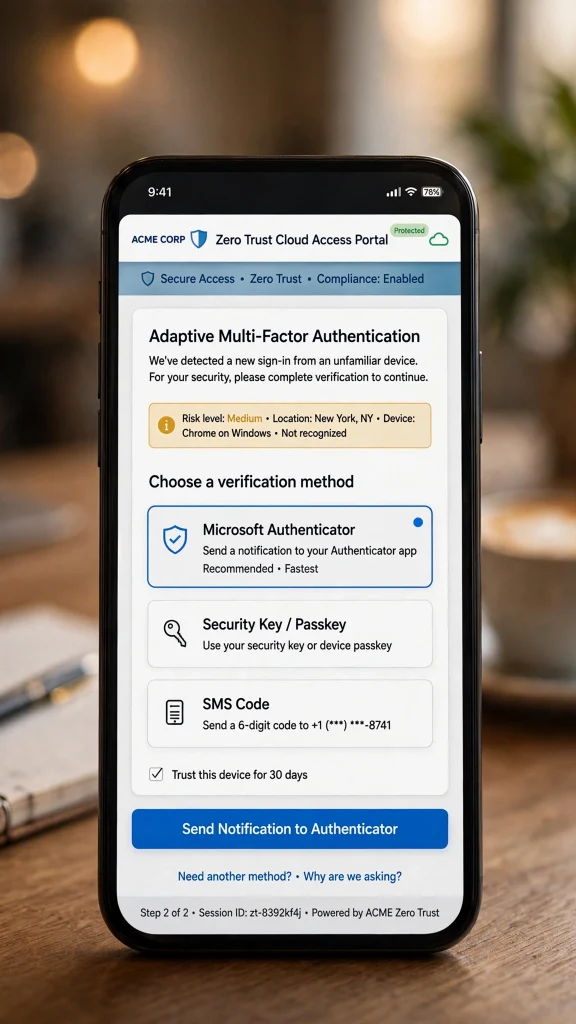
- Continuous Contextual Verification: Authentication decisions extend beyond initial login. Security policies continuously monitor user identity, device security posture, geographic location, and anomalous behaviors throughout every session.
Technical Comparison: VPN vs Zero Trust Architecture
Evaluating the functional and operational differences between traditional VPN setups and Zero Trust deployments highlights why organizations are making the switch.
| Capability / Metric | Legacy VPN Architecture | Zero Trust Architecture (ZTNA) |
|---|---|---|
| Trust Model | Point-in-time implicit trust post-login | Continuous adaptive identity & context verification |
| Access Scope | Broad network subnet level access | Granular application-level access |
| Inbound Exposure | Publicly exposed listening entry gateways | Hidden inside-out encrypted connectors |
| Lateral Movement | High vulnerability across network segments | Blocked via micro-segmentation policies |
| Cloud Integration | Sluggish traffic hairpinning through gateways | Direct-to-app multi-cloud connectivity |
| User Experience | Frequent connection drops and login prompts | Seamless background authentication |
The Strategic Business Case for Zero Trust
Transitioning from legacy VPN infrastructure to Zero Trust delivers significant risk-reduction benefits alongside tangible operational efficiencies:
1. Shrinking Breach Blast Radii: By restricting access to application-specific channels, compromised credentials cannot grant entry to adjacent databases or operational workloads, effectively isolating security incidents. 2. Streamlining IT Operations: Centralizing identity-based policies eliminates the administrative burden of manually maintaining complex IP-based access lists across disparate firewalls. Helpdesk tickets tied to VPN failures and login glitches drop substantially. 3. Optimizing Operational Expenses: While implementing Zero Trust requires upfront strategy, it eliminates expensive hardware refreshes for legacy appliances. Elastic cloud licensing allows teams to scale access capacity dynamically without over-provisioning physical hardware.
Modernizing Enterprise Remote Access
Migrating away from legacy VPN appliances does not require an abrupt rip-and-replace of existing security stacks. Modern organizations follow a phased adoption strategy to maintain business continuity while enhancing defense posture:
- Phase 1: Catalog Assets and Identity Infrastructure: Map all corporate workloads, SaaS tools, and remote user roles. Ensure identity management systems enforce universal Multi-Factor Authentication (MFA).
- Phase 2: Deploy ZTNA for High-Risk Use Cases: Roll out Zero Trust brokers for third-party vendors, remote contractors, and administrators managing sensitive workloads.
- Phase 3: Migrate Core Applications: Systematically shift private corporate applications to application-specific ZTNA connectors, prioritizing cloud-native environments.
- Phase 4: Deprecate Legacy Gateways: As adoption spreads across the organization, phase out legacy VPN concentrators to shrink the external attack surface.

Conclusion
As threat actors leverage advanced tactics to exploit perimeter vulnerabilities, relying on legacy VPNs for remote workforce connectivity presents growing organizational risk. Zero Trust network access provides a modern alternative designed specifically for distributed, cloud-first operations. By enforcing continuous identity verification and least-privilege application access, enterprises establish a secure foundation for long-term cyber resilience.