
For decades, the Virtual Private Network (VPN) served as the undisputed bedrock of enterprise remote access. By establishing an encrypted tunnel from an external device directly into the corporate network, organizations could safely extend their trusted perimeters to remote workers, traveling executives, and external partners. However, the modern threat landscape has fundamentally outgrown this legacy model. Recent security reporting highlights that enterprise VPN gateways, edge devices, and virtual appliances have become prime targets for sophisticated threat actors. Because traditional VPNs grant broad, implicit trust once authenticated, a single compromised credential or unpatched vulnerability can provide attackers with unhindered lateral movement across the entire internal corporate network.

As organizations accelerate their cloud adoption and embrace permanent hybrid work models, the limitations of traditional network perimeters have forced a critical reassessment of security architectures. Enter Zero-Trust Network Access (ZTNA). Grounded in the foundational principle of 'never trust, always verify,' ZTNA redefines how users and devices connect to enterprise resources. By decoupling access from the underlying network layer, ZTNA ensures that authentication and authorization happen continuously, shifting the focus from securing the perimeter to protecting individual applications and data assets.
The Architectural Flaws of Traditional Full-Network VPNs
To understand why ZTNA has become an essential paradigm shift, we must first examine the inherent vulnerabilities of legacy VPNs. Traditional VPN architecture relies on a castle-and-moat philosophy. Once a user successfully passes initial authentication—often relying solely on a username and password—the VPN gateway drops them directly onto the internal corporate local area network (LAN) or virtual private cloud (VPC).
From a networking perspective, the user's machine is treated as if it is physically plugged into a port inside the corporate headquarters. This creates severe security risks:
- Lateral Movement: Once inside the network perimeter, attackers or compromised endpoints can freely scan internal subnets, discover vulnerable servers, and pivot across critical business systems.
- Implicit Trust: Legacy systems assume that because a device connected via an authenticated tunnel, the user and the endpoint remain trustworthy throughout the entire session.
- Complex Management: Managing split tunneling, routing tables, firewall rules, and client software updates across thousands of remote endpoints introduces massive administrative overhead and configuration errors.
Recent exploits targeting legacy VPN appliances underscore these risks. Threat actors routinely leverage zero-day vulnerabilities in edge gateways to bypass perimeter defenses entirely, establishing persistent footholds that go undetected for weeks or months.
Core Tenets of Zero-Trust Network Access
Zero-Trust Network Access eliminates implicit trust entirely. Instead of granting network-level access, ZTNA establishes secure, encrypted, identity-aware connections directly between an authorized user and specific authorized applications.
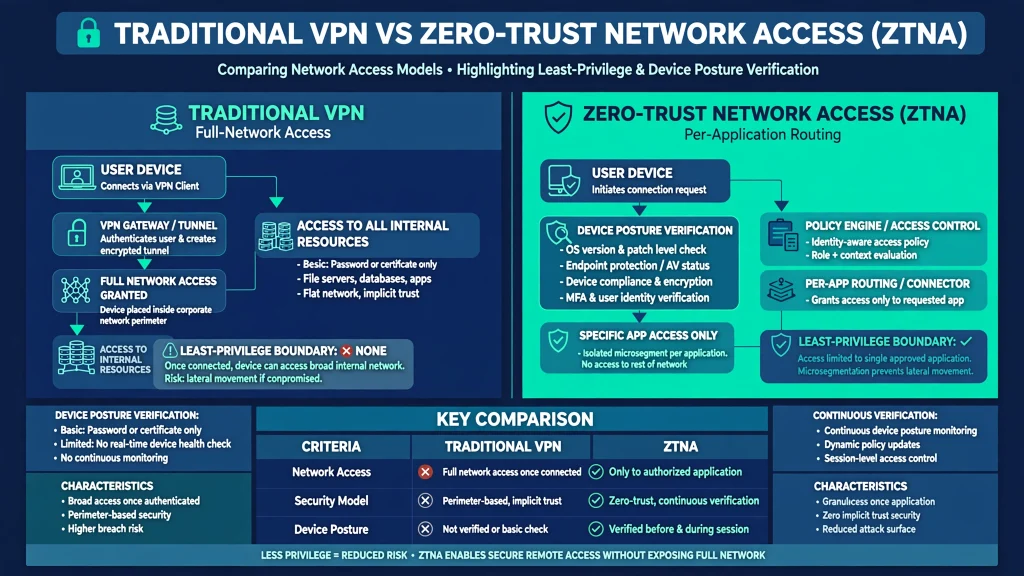
The core tenets that differentiate ZTNA from traditional VPNs can be broken down into three critical operational pillars: least-privilege access, rigorous device posture checks, and granular per-application controls.
1. Enforcing Least-Privilege Access
The principle of least-privilege dictates that users and devices should be granted only the minimum level of access necessary to perform their specific job functions—nothing more, nothing less.
In a traditional VPN environment, least-privilege is notoriously difficult to enforce. Restricting a user to a specific server often requires complex network segmentation, VLAN configurations, and internal firewall rules that quickly become brittle and unmanageable. If a finance employee needs access to one specific accounting database, a traditional VPN often exposes them to adjacent subnets hosting HR records, intellectual property, and internal tooling.
ZTNA transforms least-privilege enforcement by abstracting access away from network topology. Users are granted access strictly to designated applications based on verified identity, role, and context. Even if an attacker compromises a user's credentials, their blast radius is strictly limited to the specific applications assigned to that user identity. They cannot scan the network, discover hidden services, or pivot to unassigned systems.
2. Device Posture Checks and Continuous Validation
A fundamental weakness of traditional VPN access is its indifference toward the health and security state of the connecting device. Whether a user connects from a corporate-managed, fully patched laptop with advanced Endpoint Detection and Response (EDR) agents installed or from an unmanaged, malware-infected personal device, the legacy VPN treats them identically once credentials are verified.

ZTNA introduces continuous, real-time device posture checks as a mandatory gatekeeper before any connection is established. Before granting access to an application, the ZTNA policy engine evaluates multiple security telemetry markers:
- OS Compliance: Verifying that the operating system is running supported, patched versions.
- Security Software Status: Confirming that active enterprise EDR, antivirus, and disk encryption tools are running and up to date.
- Vulnerability Assessment: Scanning for known vulnerabilities, unauthorized software, or compromised system files.
Crucially, ZTNA does not stop at initial login. Device posture and user behavior are monitored continuously throughout the session. If an endpoint's security posture degrades—such as an EDR agent being disabled or malware being detected—the ZTNA controller can instantly revoke access or isolate the session in real time.
3. Per-Application Access vs. Subnet Tunneling
One of the most profound operational differences between VPNs and ZTNA lies in how traffic is routed and terminated.
Traditional VPNs create a network tunnel (subnet tunneling). The remote device becomes part of the enterprise network, exposing all routing paths.
ZTNA, by contrast, operates on a per-application access model. Applications are hidden from public view and are not exposed to the internet or even to the internal network unless an explicit, authenticated request is authorized. The connection operates via secure service proxies or brokers. A user connects to Application A through an encrypted micro-tunnel; they cannot see, ping, or interact with Application B, C, or any underlying network infrastructure. This eliminates attack surface exposure, rendering enterprise assets invisible to internet-based reconnaissance and scanning tools.
Comparative Overview: VPN vs. ZTNA
To clearly illustrate how these architectural differences impact security posture and operational efficiency, consider the following comparison:
| Security Dimension | Traditional Full-Network VPN | Zero-Trust Network Access (ZTNA) |
|---|---|---|
| Trust Model | Implicit trust after initial authentication. | Zero implicit trust; continuous verification. |
| Access Scope | Broad, network-level access (LAN/VPC). | Granular, per-application micro-segmentation. |
| Device Posture | Minimal or absent at connection time. | Continuous real-time endpoint health validation. |
| Attack Surface | VPN gateways and internal subnets exposed. | Applications hidden behind secure proxy brokers. |
| Lateral Movement | High risk of pivoting across internal subnets. | Isolated connections prevent lateral movement. |
| User Experience | Often requires manual client toggling and login friction. | Seamless, context-aware, identity-driven connection. |
Embracing the Future of Enterprise Security
The transition from legacy VPNs to Zero-Trust Network Access is no longer a futuristic vision; it is an urgent operational necessity. As cyber adversaries increasingly weaponize edge appliance vulnerabilities and exploit the broad lateral movement afforded by traditional perimeters, organizations must adopt architectures built for the modern hybrid workforce.
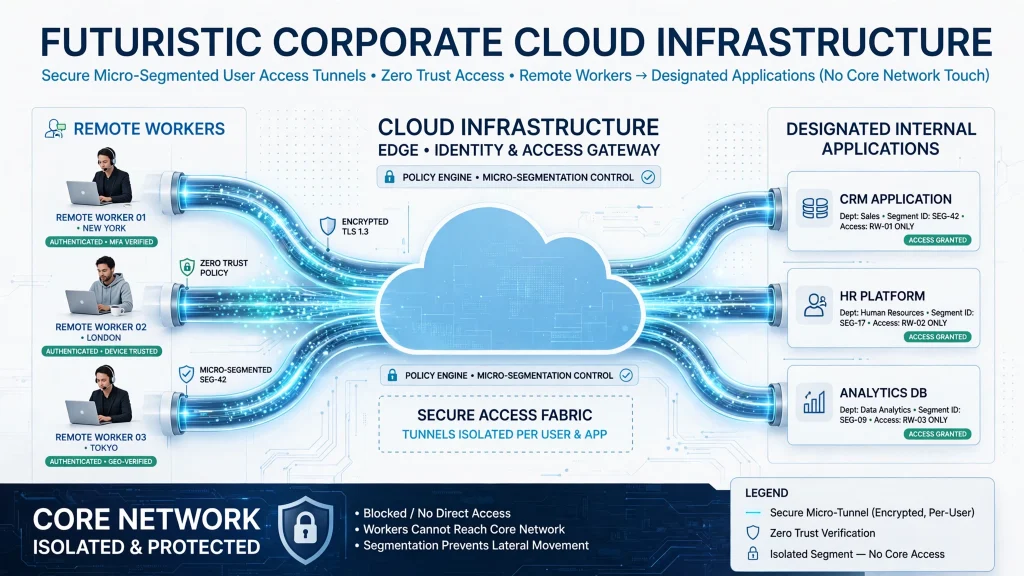
By implementing strict least-privilege access, enforcing continuous device posture validation, and shifting from subnet tunneling to per-application micro-segmentation, IT and security leaders can drastically reduce their organization's attack surface. Embracing ZTNA not only fortifies defenses against sophisticated modern threats but also lays a resilient foundation for agile, secure, and friction-free enterprise connectivity.