
What Is a VPN Concentrator and How Does It Work?
As businesses increasingly support remote employees, branch offices, and cloud-based operations, secure network connectivity has become essential. Organizations need reliable ways to connect multiple users to internal systems without exposing sensitive information to the public internet. A VPN concentrator helps solve this challenge by managing numerous secure connections through a centralized network device or software solution.
A VPN concentrator is a specialized networking appliance or virtual solution designed to establish, manage, and maintain multiple Virtual Private Network (VPN) connections simultaneously. It encrypts data, authenticates users, manages secure tunnels, and directs authorized traffic between remote devices and corporate networks.
What Is a VPN Concentrator?
A VPN concentrator is an enterprise networking solution that allows multiple remote users, branch offices, or devices to connect securely to a private network. Instead of managing every VPN connection independently, organizations use a centralized system to control authentication, encryption, traffic routing, and connection monitoring.
VPN concentrators are commonly deployed in corporate data centers, enterprise networks, and cloud environments. Depending on the implementation, they support technologies such as IPsec, SSL/TLS-based VPNs, and IKEv2.
Unlike a typical consumer VPN application, which primarily protects an individual user's internet connection, an enterprise VPN concentrator is designed to manage many simultaneous secure connections efficiently.

How Does a VPN Concentrator Work?
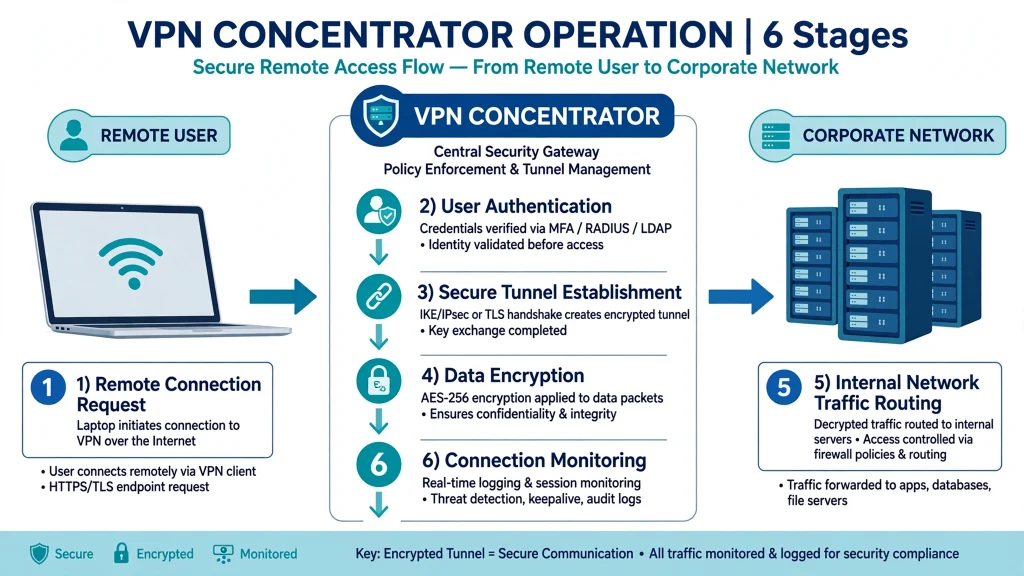
A VPN concentrator establishes encrypted communication tunnels between remote users or networks and an organization's internal infrastructure. It handles several processes to ensure that information travels securely.
The typical connection process involves these steps:
1. Connection request: A remote employee or branch office initiates a VPN connection using compatible software or network equipment. 2. Authentication: The concentrator verifies the user's identity through passwords, digital certificates, multifactor authentication, or integrated identity services. 3. Tunnel establishment: Once authentication succeeds, the system negotiates security parameters and creates an encrypted VPN tunnel. 4. Data encryption: Information transmitted over the public internet is encrypted to protect it from unauthorized access. 5. Traffic routing: The concentrator forwards approved traffic to internal applications, databases, file servers, and other authorized resources. 6. Connection monitoring: It monitors active sessions, manages tunnel performance, and applies configured security policies.
When the internal network sends information back, the concentrator processes the traffic and delivers it through the appropriate secure connection.
Key Features of a VPN Concentrator
VPN concentrators combine several important networking and security capabilities.
1. Multiple Simultaneous Connections
A major advantage is the ability to manage numerous VPN tunnels simultaneously. This makes concentrators suitable for organizations with large remote workforces, multiple offices, and geographically distributed teams.
2. Data Encryption
VPN concentrators use encryption technologies to protect information traveling across untrusted networks. Depending on the configuration, they may support AES encryption and secure key exchange mechanisms to maintain confidentiality.
3. Centralized Authentication
Administrators can integrate authentication with directory services, digital certificates, and multifactor authentication systems. These capabilities help ensure that only authorized users and devices can establish connections.
4. Traffic Management
Concentrators manage incoming and outgoing VPN traffic. Depending on the product, they may provide bandwidth management, quality of service, traffic prioritization, and session controls.
5. Monitoring and Reporting
Network teams can monitor active connections, bandwidth consumption, authentication attempts, and connection failures. These insights help identify performance issues and unusual activity.

VPN Concentrator vs. VPN Server
A VPN concentrator and a VPN server both provide secure connectivity, but their primary purposes can differ.
A VPN server accepts VPN connections, authenticates clients, and handles encrypted traffic. A VPN concentrator is generally optimized for managing many simultaneous VPN tunnels and providing centralized enterprise-level administration.
| Feature | VPN Concentrator | VPN Server |
|---|---|---|
| Main purpose | Manage multiple VPN connections | Provide VPN connectivity |
| Connection capacity | Designed for enterprise workloads | Depends on configuration |
| Administration | Centralized connection management | Varies by platform |
| Scalability | Often supports enterprise scaling | Depends on available resources |
| Typical users | Large organizations | Individuals and businesses |
| Deployment | Hardware or virtual appliance | Physical or virtual server |
These categories can overlap. A powerful VPN server can also manage thousands of connections, while modern concentrators may operate entirely as software-based appliances.
Benefits of Using a VPN Concentrator
Organizations deploy VPN concentrators to improve remote access security and simplify network administration.
Improved security: Encrypted VPN tunnels help protect confidential information transmitted across public networks. Authentication controls reduce the risk of unauthorized connections.
Centralized management: Administrators can manage user access, connection policies, and security configurations from one platform instead of maintaining separate systems for individual users.
Better scalability: Businesses can accommodate additional employees and branch offices by selecting solutions with greater connection capacity or deploying additional appliances.
Reliable connectivity: Enterprise concentrators may support redundancy, clustering, and failover capabilities, helping organizations maintain access when individual components experience problems.
Consistent security policies: Centralized configuration makes it easier to enforce authentication requirements, encryption standards, and access restrictions across remote connections.
Common Use Cases of VPN Concentrators
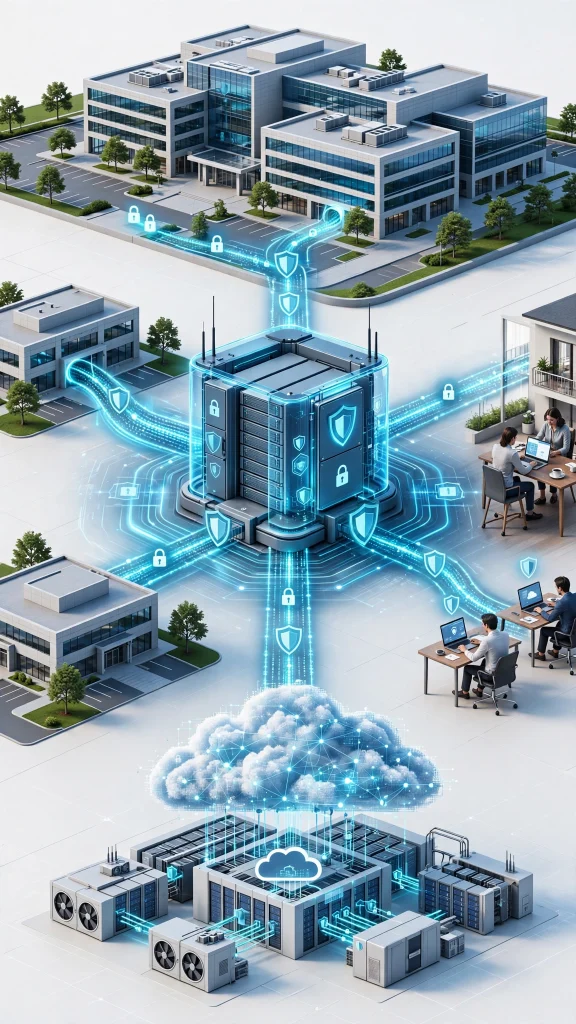
VPN concentrators are useful wherever multiple users or locations need secure access to private business resources.
- Remote employees: Staff working from home or traveling can access corporate applications and internal systems securely.
- Branch offices: Organizations can establish encrypted site-to-site connections between headquarters and geographically distributed offices.
- Business partners: Contractors and approved vendors can receive controlled access to specific company resources.
- Data centers: Businesses can securely connect remote locations with centralized servers and enterprise infrastructure.
- Cloud environments: Companies can establish VPN connections between on-premises networks and supported cloud infrastructure.
These applications make VPN concentrators valuable for businesses that depend on secure communication across multiple locations.
Hardware vs. Software VPN Concentrators
VPN concentrators are available as dedicated physical appliances and software-based solutions.
Hardware VPN concentrators are specialized devices installed within enterprise networks or data centers. They may include dedicated processors, network interfaces, and hardware acceleration to handle substantial encrypted traffic. Organizations often choose them when predictable performance and dedicated infrastructure are priorities.
Software VPN concentrators operate on physical servers, virtual machines, or supported cloud platforms. They offer deployment flexibility and can scale alongside virtual infrastructure. They are particularly useful for businesses already using virtualization and cloud services.

Neither option is universally better. The right choice depends on connection volume, encrypted throughput, infrastructure requirements, available resources, and long-term operating costs.
How to Choose the Right VPN Concentrator
Selecting an appropriate VPN concentrator requires evaluating current requirements and future growth.
Consider these important factors:
1. Connection capacity: Determine how many simultaneous VPN tunnels the solution can support. 2. Encrypted throughput: Check actual VPN performance under realistic traffic conditions rather than relying only on advertised maximum speeds. 3. Security features: Look for modern encryption, multifactor authentication, secure protocols, and regular software updates. 4. Scalability: Consider clustering, load balancing, and options for adding more appliances. 5. Compatibility: Ensure integration with existing firewalls, identity providers, endpoint systems, and cloud platforms. 6. High availability: Evaluate redundancy and automatic failover to minimize service interruptions. 7. Management capabilities: Review monitoring dashboards, reporting, troubleshooting tools, and centralized administration.
Licensing costs, technical support, maintenance requirements, and deployment complexity should also influence the purchasing decision.
Are VPN Concentrators Still Relevant?
Yes. VPN concentrators remain useful for businesses that need secure access to private networks, particularly organizations operating traditional data centers, legacy applications, and multiple office locations.
However, modern security architectures increasingly incorporate Zero Trust Network Access (ZTNA). Traditional VPNs may provide network-level access after authentication, whereas ZTNA solutions can restrict access to specific applications based on identity, device security, and contextual policies.
Many organizations combine VPN infrastructure with Zero Trust principles to support different applications and user requirements. A VPN concentrator should therefore be viewed as one component of a broader security strategy, supported by endpoint protection, regular updates, monitoring, and least-privilege access controls.
Final Thoughts
A VPN concentrator is an important enterprise networking solution that manages multiple secure VPN connections through centralized infrastructure. It provides encrypted communication, user authentication, traffic management, and connection monitoring for distributed organizations.
For businesses supporting remote employees, branch offices, and private data centers, a VPN concentrator can simplify network administration while improving secure connectivity. Choosing the right solution requires careful consideration of performance, scalability, security, compatibility, and operational costs.
As business networks continue evolving, VPN concentrators remain valuable tools for organizations seeking reliable remote access and stronger centralized network security.